

STANDARDS

Core Art Standards: VA2, VA7, VA11

CCSS: R1, R2, R3

Standards

What Is Shape?

Mosaic with a Peacock and Flowers, 3rd-4th century. Mosaic. Gift of Kirkor Minassian, 1926/Medieval Art and The Cloisters via Met Museum.org

How does the artist use small shapes to create larger shapes?

Circle. Square. Triangle. You learned these basic shapes when you were just a little kid. Shape, as an element of art, probably seems straightforward. A shape is a two-dimensional area defined by lines or color.

Did you know that some artists spend their entire careers experimenting with shape? Their innovations have opened the door for new ideas about what shape is and why it’s important.

Pieces of a Picture

An ancient Roman or Byzantine artist used small pieces of stone and tile to create the mosaic above in the 3rd or 4th century. Using irregular shapes and varied colors, the artist arranges the material into immediately recognizable shapes—a peacock and flowers. Individually, the squares, triangles, and undefined shapes are simple. But in this arrangement, they complete a complex visual puzzle.

Wassily Kandinsky (1866-1944), Top and Left, 1925. Oil on cardboard. Private Collection Wassily Vasilyevich ©Fine Art Images/Heritage-Images.

What characteristics make the shapes in this painting geometric?

Geometric Abstraction

How do the shapes interact in the 1925 work Top and Left, above? Russian artist Wassily Kandinsky (VAS-uh-lee kan-DIN-skee) uses geometric shapes, made with hard edges and angles. They create intricate, interconnected patterns. The abstract image is balanced and unified—but it represents nothing specific. Instead, it invites your imagination to react to what you see.

Henri Matisse (1869-1954), La Gerbe, 1953. Ceramic, ceramic tile embedded in plaster. Gift of Frances L. Brody ©Succession H. Matisse, Paris/© 2025 Artists Rights Society (ARS), New York.

What characteristics make these shapes organic?

Organic Simplicity

Shape can refer to more than just the basic examples—square, circle, triangle—you learned as a child. Organic shapes might have curving edges and an asymmetrical balance. They might even remind you of things found in nature, like plants or seashells.

Late in his career, French artist Henri Matisse developed a technique that involved painting sheets of white paper, cutting out shapes, and then pinning or gluing them on canvas. To create works like his 1953 La Gerbe, above, he cut the shapes and then played with different arrangements until he developed a balanced composition. The curving shapes are organic, like the leaves they represent. What shape does the arrangement itself make?

Pablo Picasso (1881-1973), Woman in Hat and Fur Collar (Marie-Thérèse Walter), 1937. Oil on canvas. ©Pablo Ruiz Picasso, VEGAP/Art Resource, NY/© 2025 Artists Rights Society (ARS), New York.

What shapes does Picasso use to compose this portrait?

Building Blocks

Turn to a person sitting near you. How would you describe the shape of their head, eyes, or nose? Could you use those shapes as building blocks to make a portrait?

Spanish artist Pablo Picasso did this and then pushed beyond the conventions of what a portrait can be. Study his 1937 Woman in Hat and Fur Collar, above. Do you think the shapes Picasso uses—large ovals for her nostrils, upside-down canoes for her eyebrows, and a star on her cheek—show how she really looked?

Turn the Page...

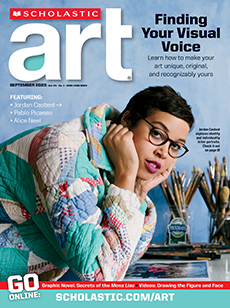
The artists featured in this issue all experimented with shape. Each started with traditional, academic training and then set out on her own, developing unique and distinctive visual vocabularies along the way. Their paths probably never crossed, so it’s unlikely any one of them influenced another. Despite this, it’s fun to compare how they use shape and why.

Text-to-Speech